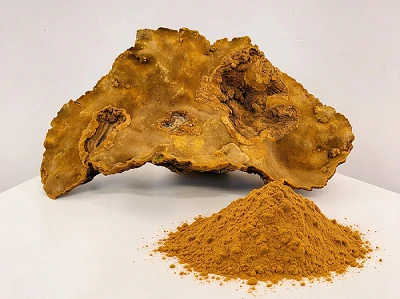
Sanghuang mushroom powder is a specialty mushroom ingredient used in traditional herbal practices and modern dietary supplement formulations. It is made from dried Sanghuang mushroom materials and contains naturally occurring polysaccharides, polyphenols, flavonoids, and other bioactive compounds.
In this blog post, we will explore what Sanghuang Mushroom Powder is, its main compounds, potential benefits, manufacturing process, and common applications. It also covers important quality factors for supplement manufacturers and bulk ingredient distributors.
Let's get started!
What Is Sanghuang Mushroom Powder?
Sanghuang Mushroom Powder is a fine powder made by drying and grinding Sanghuang mushroom materials. Sanghuang is a traditional medicinal mushroom group mainly associated with the genus Sanghuangporus. It has a long history of use in China, Japan, and Korea.
In traditional Chinese herbal records, Sanghuang has been associated with several health-related applications. Its historical use has encouraged modern researchers to study its chemical composition and biological properties.
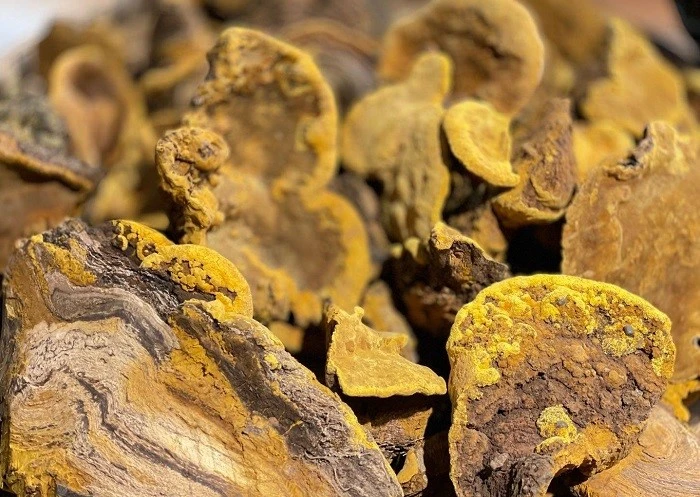
Sanghuang mushrooms usually have hard, woody fruiting bodies. Their colors range from yellowish-brown to dark brown. They commonly grow on the trunks of broadleaf trees.
Common Sanghuang Mushroom Species
Several species are used in Sanghuang-related research and commercial cultivation. True medicinal Sanghuang (Sanghuangporus sanghuang) grows exclusively on wild mulberry trees (Morus australis). While other commercial varieties exist-such as Sanghuangporus vaninii (growing on poplar trees) or Sanghuangporus baumii (growing on lilac trees)
Three commonly discussed species include:
- Sanghuangporus sanghuang: Often associated with mulberry trees, including Morus species.
- Sanghuangporus vaninii: Commonly associated with poplar trees, including Populus species.
- Sanghuangporus baumii: Commonly associated with lilac trees, including Syringa species.
Older scientific literature often uses names such as Phellinus linteus or Inonotus species. Modern molecular research has helped clarify the classification of many Sanghuang mushrooms.
Fruiting bodies and mycelium can also have different chemical profiles. Therefore, buyers should confirm which mushroom material is used in a commercial powder.
What Are the Main Bioactive Compounds in Sanghuang Mushroom Powder?
Sanghuang mushroom powder contains several groups of naturally occurring compounds. The main compounds reported in scientific studies include:
| Bioactive Compound | Main Characteristics |
|---|---|
| Polysaccharides | Complex carbohydrates and important mushroom constituents |
| Polyphenols | Phenolic compounds associated with antioxidant activity |
| Flavonoids | Plant-associated phenolic compounds also reported in mushroom materials |
| Triterpenoids | Natural compounds with diverse chemical structures |
| Phenolic Acids | Compounds involved in antioxidant-related research |
Polysaccharides
Polysaccharides are among the most studied components of Sanghuang mushrooms. They are complex carbohydrates with different molecular weights and structural features. Their composition may include glucose, mannose, galactose, xylose, and other monosaccharides. Among these, β-glucan is the most widely researched and applied.
Polyphenols and Flavonoids
Polyphenols and flavonoids are important research targets in Sanghuang mushrooms. Laboratory studies have investigated their free-radical scavenging properties and other biological activities.
Triterpenoids
Triterpenoids are another group of naturally occurring compounds reported in Sanghuang mushrooms. Essential micro-nutrients and lipid-soluble triterpenes support healthy systemic inflammatory responses and metabolic balance.
Sanghuang Mushroom Powder Benefits: What Does Scientific Research Suggest?
Modern pharmacological research increasingly supports the traditional uses of Sanghuang mushroom powder. Key health benefits documented in peer-reviewed scientific literature include:
- Immune System Modulation: Sanghuang polysaccharides stimulate key immune cells, enhancing cellular defense mechanisms.
- Antioxidant and Cellular Defense: High concentrations of polyphenolic compounds effectively neutralize free radicals, protecting lipids and DNA from oxidative degradation.
- Inflammatory Response Support: Studies suggest that active extracts from Sanghuangporus sanghuang help regulate pro-inflammatory cytokines, promoting balance in bodily tissue health.
- Metabolic and Liver Health: Sanghuang demonstrates protective properties for liver tissue and helps regulate metabolic pathways, supporting healthy blood glucose and lipid management.
How Do Polysaccharides and Polyphenols Contribute to Sanghuang Mushroom's Properties?
Polysaccharides and polyphenols work synergistically to give Sanghuang mushroom powder its therapeutic properties.
Polysaccharides (mainly beta-(1,3)-(1,6)-D-glucans) work through structural receptor binding. Once ingested, these complex sugar chains interact with specific pattern-recognition receptors located on the surfaces of gut-associated immune cells. This interaction triggers an immune-priming cascade without overstimulating the immune system.
Polyphenols and Flavonoids, on the other hand, act as biochemical shields. They donate electrons to stabilize reactive oxygen species (ROS). Furthermore, when combined with polysaccharides in a natural matrix, polyphenols protect the structural integrity of active macromolecules, ensuring higher stability and bioavailability during storage and digestional processing.
How Is Sanghuang Mushroom Powder Manufactured?
The production of food-grade and pharmaceutical-grade Sanghuang powder requires a multi-step processing line with strict controls, designed to preserve heat-sensitive compounds and eliminate contamination. A controlled manufacturing process helps maintain consistent product quality, appearance, and particle size.
Typical processing steps include:
- Raw Material Selection: Select suitable Sanghuang mushroom materials and check their identity, source, and quality.
- Picking and Sorting: Remove unsuitable materials and visible foreign matter.
- Rinsing: Clean the selected mushroom materials to remove surface impurities.
- Drying: Reduce moisture under controlled conditions to support product stability.
- Pulverization: Grind the dried mushroom materials into powder.
- Sieving: Control particle size and improve powder uniformity.
- Homogenization: Mix the powder to improve batch consistency.
- Metal Detection: Check for potential metal contamination during processing.
- Packaging: Pack the finished powder in suitable packaging to protect it from moisture and external contamination.

What Are the Common Applications of Sanghuang Mushroom Powder?
Sanghuang mushroom powder serves as a versatile raw material across several growing health and wellness product sectors:
- Dietary Supplements: Formulated into capsules, tablets, and blend formulas intended for daily immune, antioxidant, and liver health support.
- Functional Foods and Beverages: Blended into functional coffee mixtures, herbal tea formulations, wellness drink powders, and nutritional bars.
- Cosmetics and Personal Care: Used in topical skin formulations for its anti-aging, antioxidant defense, and skin-soothing properties.
- Animal Health & Veterinary Supplements: Added into high-end pet wellness supplements targeting immune longevity and vitality.
How to Evaluate Sanghuang Mushroom Powder Quality: Specifications and Testing Methods
Quality evaluation is essential when purchasing Sanghuang Mushroom Powder in bulk, You should check raw material identity, physicochemical properties, active compound content, and contaminant levels.
The following table provides an example specification reference for Sanghuang Mushroom Powder:
- Active Marker Assay: High-Performance Liquid Chromatography (HPLC) and UV-Vis spectrophotometry are used to quantify total polysaccharides, polyphenols, and flavonoid content.
- Physical Specifications: Testing mesh size (typically 80 to 120 mesh for powders), solubility, bulk density, and low moisture levels.
- Purity & Safety Screen: ICP-MS analysis for heavy metals (Lead, Arsenic, Cadmium, Mercury), multi-residue pesticide screening, and microbiology testing (total plate count, yeast/mold, E. coli, Salmonella).
- Species Identification: DNA barcoding (ITS gene sequencing) to confirm true Sanghuangporus sanghuang origin over cheaper substitutes like poplar Sanghuang.
How to Choose a Reliable Sanghuang Mushroom Powder Manufacturer?
Selecting a reliable supplier is important for supplement manufacturers, ingredient distributors, and functional food companies.
A professional supplier should provide more than a competitive quotation. Buyers should evaluate the following factors.
1. Raw Material Traceability
Ask about the mushroom source, cultivation method, fruiting body or mycelium material, and raw material identification procedures.
2. Complete Product Specifications
Request a specification sheet covering appearance, moisture, ash, polysaccharides, identification, and microbiological requirements.
3. Quality Testing and Documentation
Check whether the sanghuang mushroom powder supplier can provide:
- Certificate of Analysis (COA)
- Product specification sheet
- Safety Data Sheet (SDS)
- Heavy metal testing reports
- Microbiological testing reports
- Relevant organic certification documents, where applicable
4. Conventional and Organic Options
A supplier offering both conventional and organic Sanghuang Mushroom Powder can support a wider range of product development projects.
5. Production and Supply Capacity
Stable production capacity is important for long-term B2B purchasing. Ask about minimum order quantities, sample availability, lead times, packaging options, and bulk supply arrangements.
Looking for a Reliable Sanghuang Mushroom Powder Supplier?
We provide conventional and organic Sanghuang Mushroom Powder for dietary supplement manufacturers, nutraceutical brands, and ingredient distributors.
Our product quality control focuses on raw material selection, processing consistency, identification testing, and finished-product specifications.
Contact us to request a free sample, COA, product specification sheet, or bulk quotation. Our team is ready to discuss your sourcing requirements and support your next mushroom ingredient project.
FAQ About Sanghuang Mushroom Powder
1. What Is the Difference Between Sanghuang Mushroom Powder and Extract?
Powder is made by grinding dried mushrooms, while extract undergoes additional extraction and concentration processes.
2. What Is the Polysaccharide Content of Sanghuang Mushroom Powder?
Our Sanghuang Mushroom Powder specification lists polysaccharides at ≥1.0%. Actual results should be confirmed through the COA.
3. How Do You Test the Quality of Sanghuang Mushroom Powder?
Common tests include microscopic identification, TLC, moisture, ash, polysaccharides, heavy metals, and microbiological analysis.
4. What Is the Recommended Mesh Size for Sanghuang Mushroom Powder?
Mesh requirements depend on the intended application. Fine powder (80-120 mesh) is commonly used in capsules, tablets, and functional food formulations.
5. What Is the Shelf Life of Sanghuang Mushroom Powder?
Shelf life depends on processing, packaging, and storage conditions. Follow the manufacturer's stated shelf life and storage instructions.
Reference
1. Lu, J., Su, M., Zhou, X., Li, D., Niu, X., & Wang, Y. (2024). Research Progress of Bioactive Components in Sanghuangporus spp. Molecules, 29(6), 1195.
2. Wang, H., Ma, J. X., Wu, D. M., Gao, N., Si, J., & Cui, B. K. (2023). Identifying Bioactive Ingredients and Antioxidant Activities of Wild Sanghuangporus Species of Medicinal Fungi. Journal of Fungi, 9(2), 242.
3. Wang, H., Ma, J. X., Zhou, M., Si, J., & Cui, B. K. (2022). Current Advances and Potential Trends of the Polysaccharides Derived from Medicinal Mushrooms Sanghuang. Frontiers in Microbiology, 13, 965934.
4. Extraction, Structure and Bioactivities of Polysaccharides from Sanghuangporus spp.: A Review. (2023). Food Bioscience, 53, 102587.
5. A Review on the Extraction, Structural Analysis, and Antitumor Mechanisms of Sanghuangporus Polysaccharides. (2025). Foods, 14(4), 707.